
ISBN: 0307717720
Author: Frank Calabrese Jr.
Operation Family Secrets is the chilling true story of how the son of the most violent mobster in Chicago made the unprecedented decision to work with the FBI and the U.S. Attorney’s Office to incriminate his own father and to help bring down the last great American crime syndicate—the one-hundred-year-old Chicago Outfit.
The Calabrese family of Chicago is a close-knit, middle-class, multi-generational Italian-Irish-American clan. They operate family businesses. They work day and night striving for the American Dream. All three sons forge a bond with their controlling father, Frank Sr., and their soft-spoken favorite uncle, Nick. As a boy, the oldest son, Frank Jr., Read the rest of this entry »
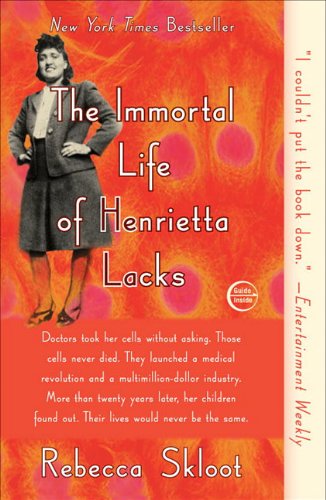
ISBN: 1400052181
Author: Rebecca Skloot
Her name was Henrietta Lacks, but scientists know her as HeLa. She was a poor Southern tobacco farmer who worked the same land as her slave ancestors, yet her cells—taken without her knowledge—became one of the most important tools in medicine. The first “immortal” human cells grown in culture, they are still alive today, though she has been dead for more than sixty years. If you could pile all HeLa cells ever grown onto a scale, they’d weigh more than 50 million metric tons—as much as a hundred Empire State Buildings. HeLa cells were vital for developing the polio vaccine; uncovered secrets of cancer, viruses, and the atom bomb’s effects; helped lead to important advances like in vitro fertilization, cloning, and gene mapping; and have been bought and sold by the billions.
Yet Henrietta Lacks remains virtually unknown, buried in an unmarked grave. Read the rest of this entry »

ISBN: 1416567445
Author: Douglas Waller
He was one of America’s most exciting and secretive generals—the man Franklin Roosevelt made his top spy in World War II. A mythic figure whose legacy is still intensely debated, “Wild Bill” Donovan was director of the Office of Strategic Services (the country’s first national intelligence agency) and the father of today’s CIA. Donovan introduced the nation to the dark arts of covert warfare on a scale it had never seen before. Now, veteran journalist Douglas Waller has mined government and private archives throughout the United States and England, drawn on thousands of pages of recently declassified documents, and interviewed scores of Donovan’s relatives, friends, and associates to produce a riveting biography of one of the most powerful men in modern espionage.
William Joseph Donovan’s life was packed with personal drama. The son of poor Irish Catholic parents, he married into Protestant wealth and fought heroically in World War I, where he earned the nickname “Wild Bill” for his intense leadership and the Medal of Honor for his heroism. After the war he made millions as a Republican lawyer on Wall Street until FDR, a Democrat, tapped him to be his strategic intelligence chief. A charismatic leader, Donovan was revered by his secret agents. Read the rest of this entry »

ISBN: 1416587241
Author: Janet Jackson
ONE OF THE GREATEST ENTERTAINERS OF OUR TIME CANDIDLY REVEALS HER VERY PERSONAL STRUGGLE WITH AN ISSUE SO MANY OF US FACE EVERY DAY: SELF-ESTEEM
Janet Jackson emerged from the shadows of an already famous family to become one of the most beloved, recognizable, and influential performers in the world. But at what cost?
From the age of ten, when she made her acting debut on Good Times, Janet was told by Hollywood that she needed to slim down. Her well-meaning brothers, especially fun-loving Michael, teased her relentlessly until she began to believe that who she was wasn’t good enough. It was an idea that no amount of critical acclaim in television and film or, later, international platinum success in music could change.
Janet turned to food for comfort and escape. She developed a self-destructive pattern familiar to so many of us: fear and uncertainty led to bad feelings about herself and ultimately depression. The depression led to overeating. And her yo-yoing weight was painfully obvious in the bright lights of the entertainment world.
It has taken Janet most of her adult life to come to terms with who she is. But she has finally broken free of the attitudes that brought her down and has embraced realistic goals that help her eat better, exercise better, feel better, and ultimately be better. Read the rest of this entry »

ISBN: 0307463907
Author: Frank Brady
Endgame is acclaimed biographer Frank Brady’s decades-in-the-making tracing of the meteoric ascent—and confounding descent—of enigmatic genius Bobby Fischer. Only Brady, who met Fischer when the prodigy was only 10 and shared with him some of his most dramatic triumphs, could have written this book, which has much to say about the nature of American celebrity and the distorting effects of fame. Drawing from Fischer family archives, recently released FBI files, and Bobby’s own emails, this account is unique in that it limns Fischer’s entire life—an odyssey that took the Brooklyn-raised chess champion from an impoverished childhood to the covers of Time, Life and Newsweek to recognition as “the most famous man in the world” to notorious recluse.
At first all one noticed was how gifted Fischer was. Possessing a 181 I.Q. and remarkable powers of concentration, Bobby memorized hundreds of chess books in several languages, and he was only 13 when he became the youngest chess master in U.S. history. But his strange behavior started early. In 1972, at the historic Cold War showdown in Reykjavik, Iceland, where he faced Soviet champion Boris Spassky, Fischer made headlines with hundreds of petty demands that nearly ended the competition.
It was merely a prelude to what was to come.
Arriving back in the United States to a hero’s welcome, Bobby was mobbed wherever he went—a figure as exotic and improbable as any American pop culture had yet produced. No player of a mere “board game” had ever ascended to such heights. Read the rest of this entry »


